7 Common Mistakes In Political Sign Printing You Should Avoid
Quick Summary
Campaign signs lose value when printing errors make them hard to read or cause them to wear out quickly. A focused layout with the candidate’s name, the office, and a short call to vote reads best from the road. Poly coated signs suit races of six to eight weeks, and corrugated plastic lasts two to three years for longer or repeat campaigns. Match size to traffic speed, choose bold colors and fonts, proof carefully, add required disclaimers, and order early with enough holders to keep signs working through Election Day.
A campaign sign may have only a few seconds to catch the attention of someone driving past. When the printing or design misses the mark, those few seconds can pass without the candidate’s name registering. At PoliticalLawnSigns.com, we have printed campaign signage for candidates across the country for decades.
The same political sign mistakes tend to appear from one election to the next. Fortunately, most are straightforward to avoid when campaigns take time to review their designs, materials, quantities, and timelines before placing an order.
Why Political Sign Mistakes Hurt a Campaign
Yard signs serve as consistent reminders of a candidate’s name. They line commuting routes, school roads, residential streets, and busy intersections, putting the same message in front of nearby voters multiple times throughout the day. When a sign becomes difficult to read or starts deteriorating too soon, it loses some of that repeated visibility.
A faded, damaged, or poorly printed sign can also make a campaign look less polished. Voters may notice these details even during a quick glance from the road. Getting the printing and design right before production helps protect the campaign budget while keeping the candidate’s name clear and presentable throughout the final stretch of the race.
Cramming Too Much Onto One Sign
Candidates have plenty of information they may want to share, which can make it tempting to squeeze a slogan, website, endorsements, photograph, and other details onto the same sign. The problem is that drivers traveling at road speed have very little time to process all of that information. A crowded layout makes the eye work harder to find the candidate’s name, which should remain one of the easiest elements to recognize.
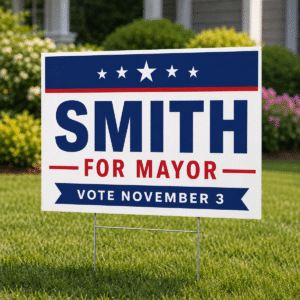
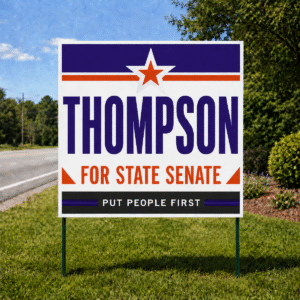
Keep the design focused on three elements: the candidate’s name, the office sought, and one short call to vote. Anything beyond that belongs on palm cards, door hangers, or your campaign website. Even on standard 18×24 political campaign yard signs, generous spacing and a bold name will do far more work than a busy design packed with small text.
Choosing the Wrong Material for Your Timeline
The material affects both the cost and expected outdoor lifespan of a campaign sign. Choosing a material that does not fit the length of the campaign can leave a candidate replacing signs before Election Day. Poly-coated cardboard and corrugated plastic each have different strengths, so the right choice depends largely on how long the signs need to remain outdoors.
- Poly-coated cardboard: A lower-cost option that holds up outdoors for about six to eight weeks, which suits short primaries, rallies, and final push efforts.
- Corrugated plastic: Slightly more expensive, yet it lasts two to three years outdoors, making it a smart pick for long races or candidates planning to run again.
Campaigns that plan to reuse signs in a future election often find corrugated plastic to be the better value over time. A short race with a tight budget can still get solid results from poly-coated signs when the timeline fits.
Picking a Size That Doesn’t Suit the Location
Sign size should match where the sign will stand and how fast people move past it. A small sign works well on a front lawn along a quiet residential street, where pedestrians and slow traffic can read the message with ease. Along a highway or a four-lane road, that same sign becomes almost invisible. Busier spots call for larger formats, such as 24×36 large political campaign yard signs on corner lots or 4×4 large political road signs near major intersections.
High-speed corridors and open fields benefit from 4×8 large political road signs, which give drivers enough time to catch the name from a distance. Mapping out your placement plan before ordering helps you split your quantity across sizes sensibly.
Using Colors and Fonts That Are Hard to Read
A design that looks clear and attractive on a computer monitor may not have the same impact when viewed across a lawn, roadside, or parking lot. Low-contrast combinations, such as yellow lettering on white or navy on black, can blend together as viewing distance increases. Thin, decorative, or script fonts create another problem because their finer strokes can disappear from the street.
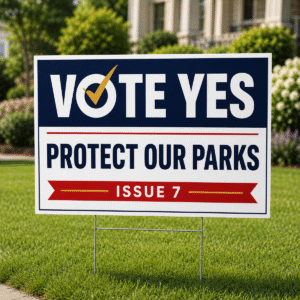
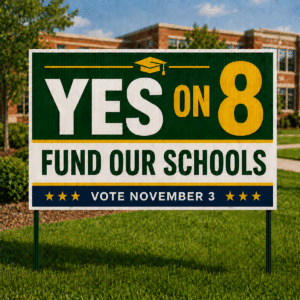
Choose bold, clean typefaces and colors with strong contrast. Dark lettering on a light background or white lettering on a deep background generally remains easier to distinguish in different lighting conditions.
Screen printing with one or two ink colors can also produce a clear, readable design at a lower price than full-color printing. A restrained color palette can therefore benefit both readability and the campaign budget.
Skipping a Careful Proof Review
One typo repeated across an entire order can be expensive to correct. A misspelled candidate name, incorrect election date, or outdated website address can also create an unnecessary problem during a local campaign. Proofs give campaigns an opportunity to catch these errors, so they should receive a careful review before approval.
A short checklist can help identify common problems:
- Spelling: Confirm the candidate’s name, office title, and any slogans letter by letter.
- Details: Double-check the election date, district number, and website address.
- Legibility: View the proof at a small size on your screen to mimic how it will look from the road.
- Fresh eyes: Ask a volunteer or staff member who has not seen the design yet to give it one more look.
Leaving Off Required Disclaimers
Political campaign finance rules in many states and local jurisdictions require a “Paid for by” notice on campaign signage. Exact wording, font size, and placement requirements can vary, and an absent or improperly formatted disclaimer may result in complaints, penalties, or other issues.
Check the applicable requirements with your state election office or local clerk before finalizing the artwork. Building the disclaimer into the design from the beginning prevents it from crowding the layout later or forcing a reprint. Local ordinances may also regulate where and when campaign signs can be displayed, so reviewing placement rules early can prevent problems after the signs arrive.
Ordering Too Late or Too Few
Printing, shipping, and installation all require time. Waiting until the final weeks of a campaign can put pressure on every stage of the process. Demand for signs may also increase once voters begin seeing them in their neighborhoods. Running out at that point can mean missing opportunities to place signs at desirable locations.
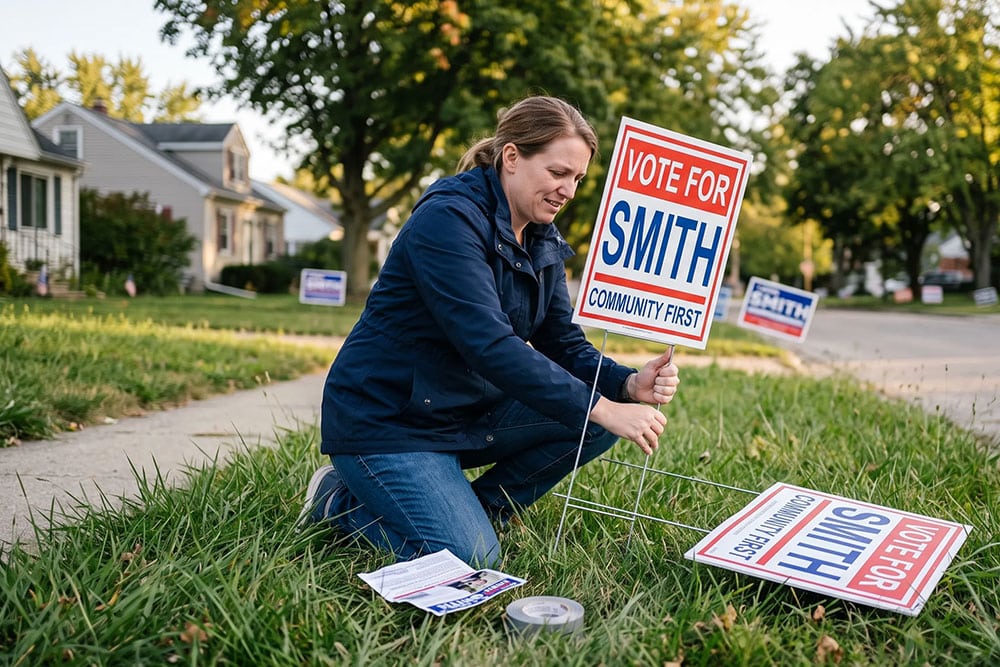
A practical quantity plan should cover confirmed locations while leaving room for new requests, damaged signs, and signs that disappear from the field. It is also important to order the necessary hardware. Signs without H frames, U frames, or stakes may end up sitting in storage rather than being installed. Matching the hardware to the number and size of signs keeps installation moving smoothly.
Ordering early also gives the campaign more time to address design changes, shipping delays, additional placement requests, or other unexpected issues without paying for rush production.
Steering Clear of Political Sign Mistakes Before Election Day
Effective campaign signs come from a handful of smart decisions made early. A focused design, a material suited to your timeline, sizes matched to each location, readable colors, a careful proof, proper disclaimers, and an order placed with time to spare all add up to signs that keep your name visible and professional through the last day of voting.
As a Made in the USA printer with decades of political signage experience, our customer service team walks candidates through these choices before anything goes to press. Talk with our sign specialists, and we will help you plan signs that work as hard as your campaign does.
FAQs
How do I estimate how many signs my campaign needs?
Start with a list of confirmed spots from volunteers, local businesses, and homeowners who have agreed to host a sign. Add extra signs for busy roads and early voting sites, and keep a reserve on hand because requests often climb once the first signs appear.
Can I reuse signs from a past election?
Corrugated plastic signs can often be reused if they are still in good condition and the office sought stays the same. Leaving the election year and specific dates off the original design makes future reuse far easier.
Should campaign signs be printed on one side or both sides?
A sign facing traffic head-on can work with a single printed side. Signs positioned where drivers approach from both directions benefit from printing on both sides, and fold-over poly-coated signs offer two readable faces by design.