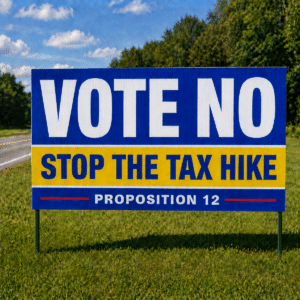
Quick Summary Yard sign placement laws vary widely between states, counties, and cities, but nearly all jurisdictions share the same core restrictions: no signs on public rights-of-way, mandatory buffer zones around polling places, disclaimer requirements in many states, and post-election removal deadlines ranging from 10 to 30 days. HOA rules add another layer that state […]
Quick Summary Poly-coated political signs are the practical choice when a campaign runs short, the budget is tight, or signs need to move around quickly between events. They perform well in mild weather and indoor-adjacent placements, and the fold-over design delivers two-sided visibility without added cost. Campaigns that match material to placement and timeline get […]
Quick Summary Candidate name and office are the only fundamentals on a political yard sign; everything else risks shrinking the name and reducing readability at speed. Sans-serif fonts, high-contrast color pairings, and a clean layout with visual hierarchy do most of the heavy lifting. Skipping election dates extends sign reuse across cycles, and testing the […]
Quick Summary One sign per 30 registered voters is a practical starting point for a city council race, but district geography, name recognition, voter turnout, and confirmed placement locations all significantly adjust that number. First-time candidates and challengers consistently need more signs than incumbents. Ordering 15 to 20 percent above your estimated need protects against […]
Quick Summary Corrugated political yard signs hold up for 2 to 3 years outdoors when placed and maintained well. UV exposure does the most damage over time, followed by wind stress and ground moisture at the base. Smart placement, proper staking, and dry storage between campaigns can extend a single set of signs across multiple […]
Quick Summary Poly-coated signs cost less upfront and work well for short campaigns, events, and high-volume distribution runs. Corrugated plastic costs more per unit but lasts 2 to 3 years outdoors, making it the more economical choice across longer races or multiple election cycles. Order quantity, sign size, print method, and hardware all affect the […]
Quick Summary Corrugated plastic lasts 2 to 3 years outdoors, making it the practical choice for long campaigns and permanent yard placements. Poly-coated cardboard lasts 6 to 8 weeks, keeping costs low for short-term races and events. Many campaigns get the most out of their budget by using both materials strategically, matching each sign type […]
Quick Summary Sign size should follow traffic speed, race scale, and placement location rather than personal preference or budget alone. Local races cover most placements well with 12×18 and 18×24 signs in volume. Larger geographic races need a mixed order, with standard sizes for residential areas and 24×36 or bigger for high-speed roads. Road signs […]
Design decisions shape how voters notice and remember a candidate long before they read a full message. To design campaign signs that work in real conditions, campaigns must think beyond looks and focus on speed, clarity, and visibility. Yard signs often receive only a brief glance from passing drivers or pedestrians, which makes layout and […]
Political yard signs appear simple, yet size plays a quiet role in how messages land with voters. Political yard sign sizes affect readability, placement options, and how often a sign actually gets noticed in daily routines. Campaigns that understand size differences tend to make smarter decisions about visibility, budget use, and overall message reach. Choosing […]