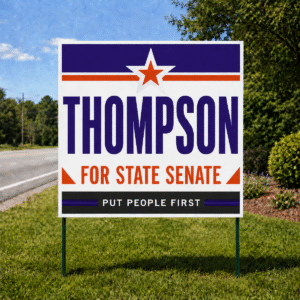
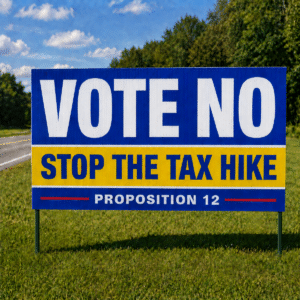
Quick Summary The best yard sign stake depends on sign size, material, soil type, and wind exposure. H frames work well for everyday corrugated lawn signs, while 30-inch and heavy-duty versions add stability in soft soil or windy areas. Spider stakes are easier to drive into firm or rocky ground, while U frames pair with […]
Quick Summary Creative political signs work when every creative choice makes the candidate’s name and office easier to read from a moving car, not harder. The strongest ideas are simple ones: a bold two-color pairing, a slogan of three or four words, one clean icon, and a mix of sign sizes that matches where voters […]
Quick Summary To keep yard signs from blowing over, match the stake to the sign’s size, push the legs deep into firm ground, and slide the sign all the way down so the wires sit fully inside the corrugated flutes. The fixes that matter most are simple: a heavier holder for anything larger than a […]
Quick Summary Images on political signs work best when the sign is large enough to accommodate them or when viewers see the sign from relatively close range. On smaller lawn signs, a bold candidate name paired with a simple icon or logo usually makes the name easier to remember than a headshot. Photos require digital […]
Quick Summary Double-sided yard signs reach drivers approaching from both directions, giving one placement more exposure without requiring another location. Printing on a second side typically costs less than purchasing a separate sign and can reduce the number of holders, installation hours, and replacement units a campaign needs. A printed back also gives the sign […]
Quick Summary Campaign signs lose value when printing errors make them hard to read or cause them to wear out quickly. A focused layout with the candidate’s name, the office, and a short call to vote reads best from the road. Poly coated signs suit races of six to eight weeks, and corrugated plastic lasts […]
Quick Summary Yard sign placement laws vary widely between states, counties, and cities, but nearly all jurisdictions share the same core restrictions: no signs on public rights-of-way, mandatory buffer zones around polling places, disclaimer requirements in many states, and post-election removal deadlines ranging from 10 to 30 days. HOA rules add another layer that state […]
Quick Summary Poly-coated political signs are the practical choice when a campaign runs short, the budget is tight, or signs need to move around quickly between events. They perform well in mild weather and indoor-adjacent placements, and the fold-over design delivers two-sided visibility without added cost. Campaigns that match material to placement and timeline get […]
Quick Summary Candidate name and office are the only fundamentals on a political yard sign; everything else risks shrinking the name and reducing readability at speed. Sans-serif fonts, high-contrast color pairings, and a clean layout with visual hierarchy do most of the heavy lifting. Skipping election dates extends sign reuse across cycles, and testing the […]
Quick Summary One sign per 30 registered voters is a practical starting point for a city council race, but district geography, name recognition, voter turnout, and confirmed placement locations all significantly adjust that number. First-time candidates and challengers consistently need more signs than incumbents. Ordering 15 to 20 percent above your estimated need protects against […]